Storyboarding and Why It Is Necessary
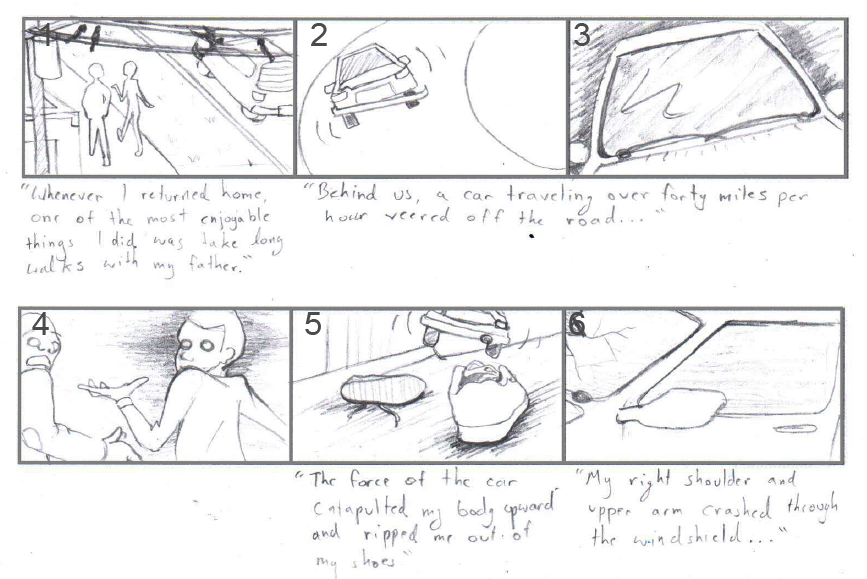
Storyboarding is the visualization of a script for your video or animation, typically as a sequence of drawn or mocked up images that convey timing, composition and movement of scenes. Any video or animation that is being planned out beforehand should receive a storyboard. Such projects we call "Create-What-You-Want" videos. You can read more about those at this link. But in short, these are videos that are scripted and planned in detail before production begins. Common example are movies, commercials and anything animated.
Storyboards are critical for:
- Communication of a plan,
- Conducting that plan efficiently,
- And acting as a safe guard against costly revisions
Communication
We like to compare storyboards to a blueprint for a house an architect draws up. First off, the blueprint communicates what a home will look like to the buyer. Furthermore, it is only drawn within the realm of what is possible financially, technically and within the time available. A storyboard for a client, will be the same.
Efficiency
The blueprint is also a plan for how a team will proceed with building, from the foundation up. Perhaps one has built many houses could proceed without a blueprint but it is likely that even with their immense knowledge and experience, mistakes will be made and the project will be done poorly. One can imagine it would be difficult to build a house from only a concept. A video, and especially and animation, would be just as tricky.
Control "Beyond Scope" Costs
Lastly, a storyboard is of particular importance to the producer in that it acts as a safeguard against extensive revisions that blow up the budget. To go back to the blueprint analogy, if the homebuyer asked for another room to be built in their half-built home, the builder will point out that the room is not in the approved blueprint. If it's possible physically, the buyer may pay extra for this additional feature. Likewise with video production, if a client wants another scene added in, the producer can point to the storyboard and say that the scene wasn't there when you agreed to pay X for what's in the storyboard. We can create the extra scene, but it will cost X+Y.
For the reasons above, storyboarding is absolutely necessary for animation since animation is time consuming to create. It is so important to us, that even if we're in the rare situation where the client is not paying for a storyboard, we'll still draw up a very simple, very rough storyboard to use internally (like chicken scratch doodles that wouldn't make sense to anyone else!)
It is only on a very rare occasion where we wouldn't do a storyboard for a client and only as a last resort. Usually for budgetary reasons and/or the animation will be incredibly straight forward. Or, we have built up such a relationship with the client, that there is a strong trust of our work. Or lastly, we're using a consistent template for a similar, repeating animation. Only for those reasons, we may forgo the storyboarding phase.

Again, you wouldn't build a house without a blueprint, and likewise, you shouldn't build an animated video without a storyboard!
Need help planning your next animation or video?
Contact us at hello@kohlitz.com